One objective with a small set of measurable key results and a useful review routine.
A real problem to improve and an agreed planning period. Use a Klara account to put the example into practice.
Meet Maya Bennett, a fictional Head of Operations. All screenshots show her demo workspace in the current Klara interface.
1. What makes an objective useful?
Start with the problem, not the metric. Who should experience a better result by the end of the period? “Make onboarding easier for new customers” gives a team a clearer direction than “Improve onboarding”. Keep the objective short enough to remember and specific enough to guide trade-offs.
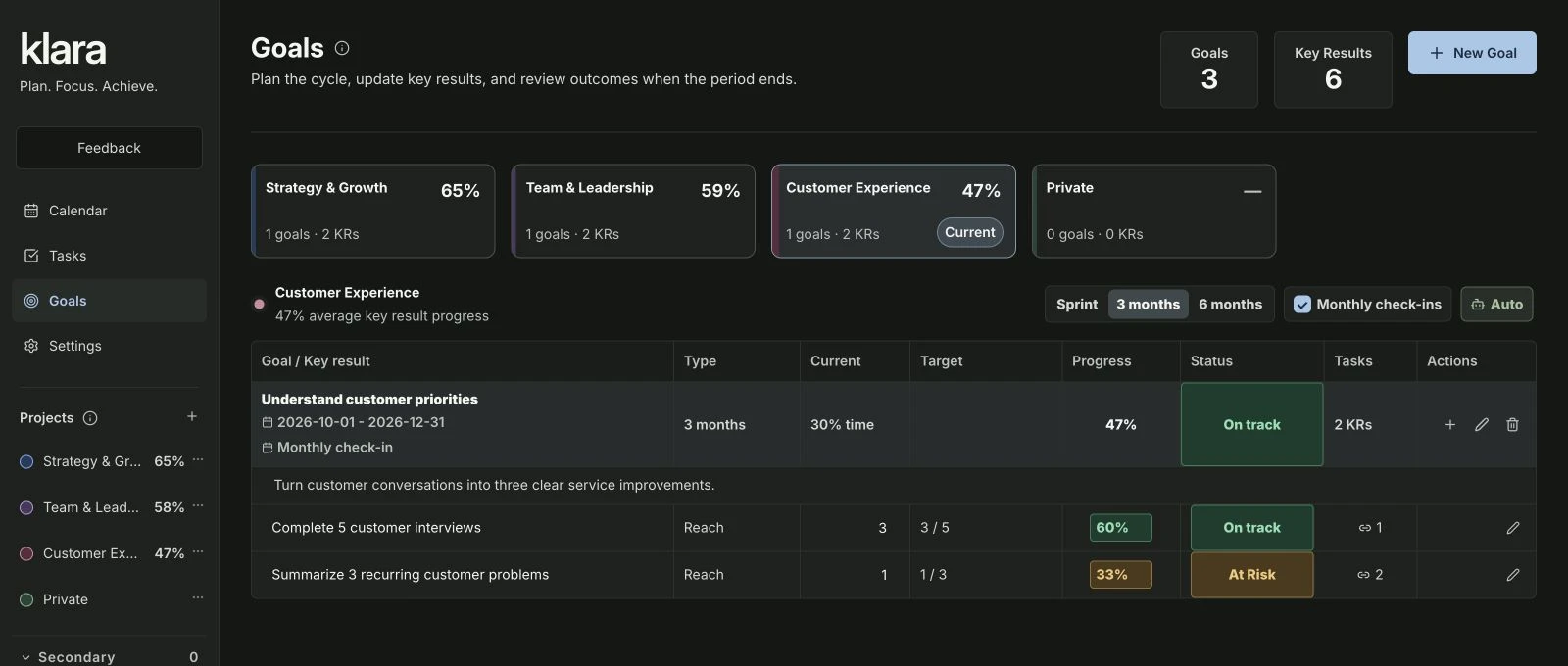
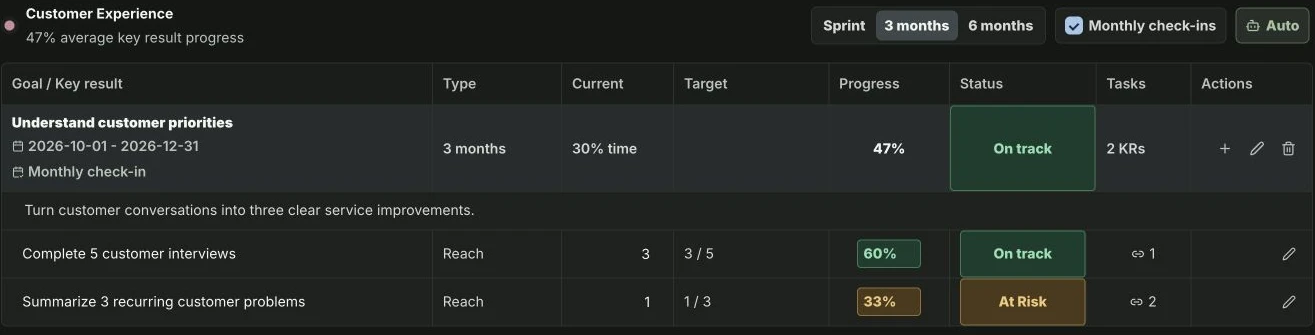
Maya’s demo uses “Understand customer priorities”, a discovery objective. It is a useful first step, but a mature customer-experience OKR should also test whether customers experience an improvement. The examples below develop that idea; they are writing examples, not extra data in her workspace.
2. What makes a key result measurable?
Consider an illustrative quarter ending 31 December: the objective is “Make onboarding easier for new customers”. The three stronger key results below would measure activation, speed and customer experience for that same objective. Decide how each metric will be measured before agreeing the targets.
| Weak key result | Stronger example | Evidence to check |
|---|---|---|
| Work on onboarding | Increase new-customer activation from 40% to 55% by quarter end | The same defined activation event and customer cohort |
| Run more training | Reduce median time to first successful setup from 5 days to 3 days | Setup timestamps using the same start and end definitions |
| Ask for feedback | Increase onboarding satisfaction from 3.6 to 4.2 out of 5 | The same question, survey timing and response coverage |
These numbers are illustrative. Use a baseline you have actually measured and a target that reflects your situation. If the baseline is missing, measure it first. State the period, metric definition, data source and who will update it. A percentage without a clear denominator is easy to misread.
3. How do tasks contribute to an OKR?
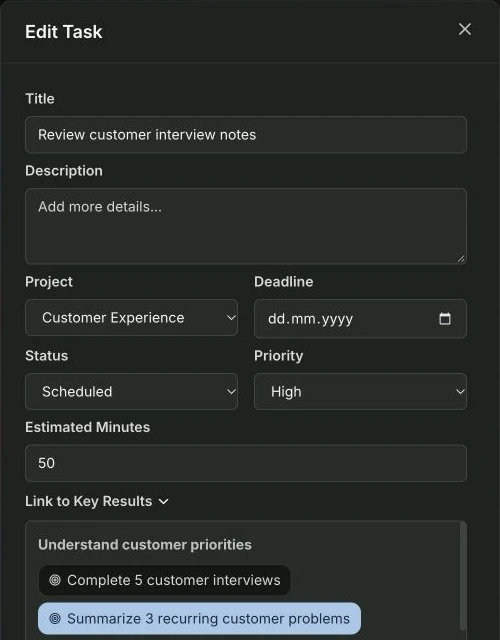
In Klara, create the objective in Goals and add its key results. Then choose the tasks most likely to move those results. “Review customer interview notes” is an action; “Summarize 3 recurring customer problems” is Maya’s related learning milestone. Link only the tasks where the connection helps explain the work.
- ObjectiveWhat should improve?
- EvidenceHow will we know?
- ActionWhat will we try?
- ReviewDid the result change?
Once the objective and evidence are clear, use the task-linking workflow to plan the work that may improve them. Connect a goal to its next concrete task →
4. How do you review OKRs against real evidence?
Choose a regular review, for example during weekly planning. Update results from the agreed source, discuss what changed and decide whether the next tasks still make sense. Completed cards do not automatically prove that an outcome improved. If the measure can be improved while the customer experience gets worse, add a quality check or choose a better measure.
| Check | Question |
|---|---|
| Value | Would success make a meaningful difference? |
| Clarity | Could two people measure this in the same way? |
| Scope | Can we influence it within the agreed period? |
| Evidence | Do we know the baseline and where updates come from? |
| Integrity | Could the metric rise while the real outcome gets worse? |
Further reading
About this guide and its examples
Published by Klara. Written with AI assistance; product behavior checked on . Goal creation, key-result editing and optional task linking were checked. The improved metrics below are illustrative writing examples, not measured customer results.
Screenshots were captured in the fictional Maya Bennett demo workspace on 28–29 October 2026. Illustrative calculations and suggested OKR targets are examples, not measured customer results. For corrections or questions, use the contact details in our legal notice.